New 3D-Printed Oil & Gas Requirements: A Rapid Gap Analysis to Drive AM Parts in Energy
New requirements could help energy companies bring more 3D-printed components into service. A StandardFlow demonstration explores how AI-assisted gap analysis could help manufacturers put them into practice.
The oil and gas industry has taken another step toward making additive manufacturing (AM) a more practical option for producing critical components.
On November 11, the International Association of Oil & Gas Producers (IOGP) published Report 837, Supplementary requirements for Additive Manufacturing (AM) to API 6D. The new technical specification establishes additional requirements for producing certain valves and valve components using metal 3D printing.
The publication follows IOGP Report 820, Quality guideline for Additive Manufacturing (AM), released just one week earlier. Together, the documents provide a more consistent framework for evaluating, purchasing, and qualifying additively manufactured parts for the energy industry.
The opportunity for AM in energy is enormous. Optimized, 3D printed components in oil and gas could be critical to improving the efficiency of fuel production, thus also decreasing its overall cost. Producing replacement parts closer to where they are needed could help energy companies reduce dependence on distant suppliers, long production lead times, and extensive physical inventories.
But realizing those benefits requires confidence that printed components can meet the same demanding expectations for quality, performance, and traceability as traditionally manufactured parts.
The new IOGP requirements provide another step toward making that confidence possible.
A clearer route from 3D printing to acceptance
For manufacturers, the challenge is often understanding exactly what must be demonstrated before a customer can accept a printed component.
A supplier may have manufacturing records, material test results, and inspection reports, but those documents must collectively establish that the appropriate requirements have been met.
For an energy company, the questions are equally important: Was the component manufactured using an acceptable process? Were the correct tests performed? Does the available evidence support its intended operating conditions?
Report 837 helps make these expectations more explicit.
Building on the established API 6D valve specification, it introduces requirements addressing manufacturing processes, material qualification, mechanical properties, inspection, marking, and documentation.
It also establishes important limitations. Certain applications and components are excluded, including specified sour-service applications and additively manufactured pressure-boundary bolting. Repair of additively manufactured valve components is prohibited.
The report builds on existing industry standards rather than replacing them. Manufacturers and purchasers still need to apply the relevant specifications and make appropriate engineering decisions.
Its practical value is a clearer basis for agreeing on what a printed component must demonstrate before it can be considered for acceptance.
Turning new requirements into a working review
To explore how manufacturers could begin applying these requirements, StandardFlow created a fictional technical documentation package for a metal 3D-printed valve body.
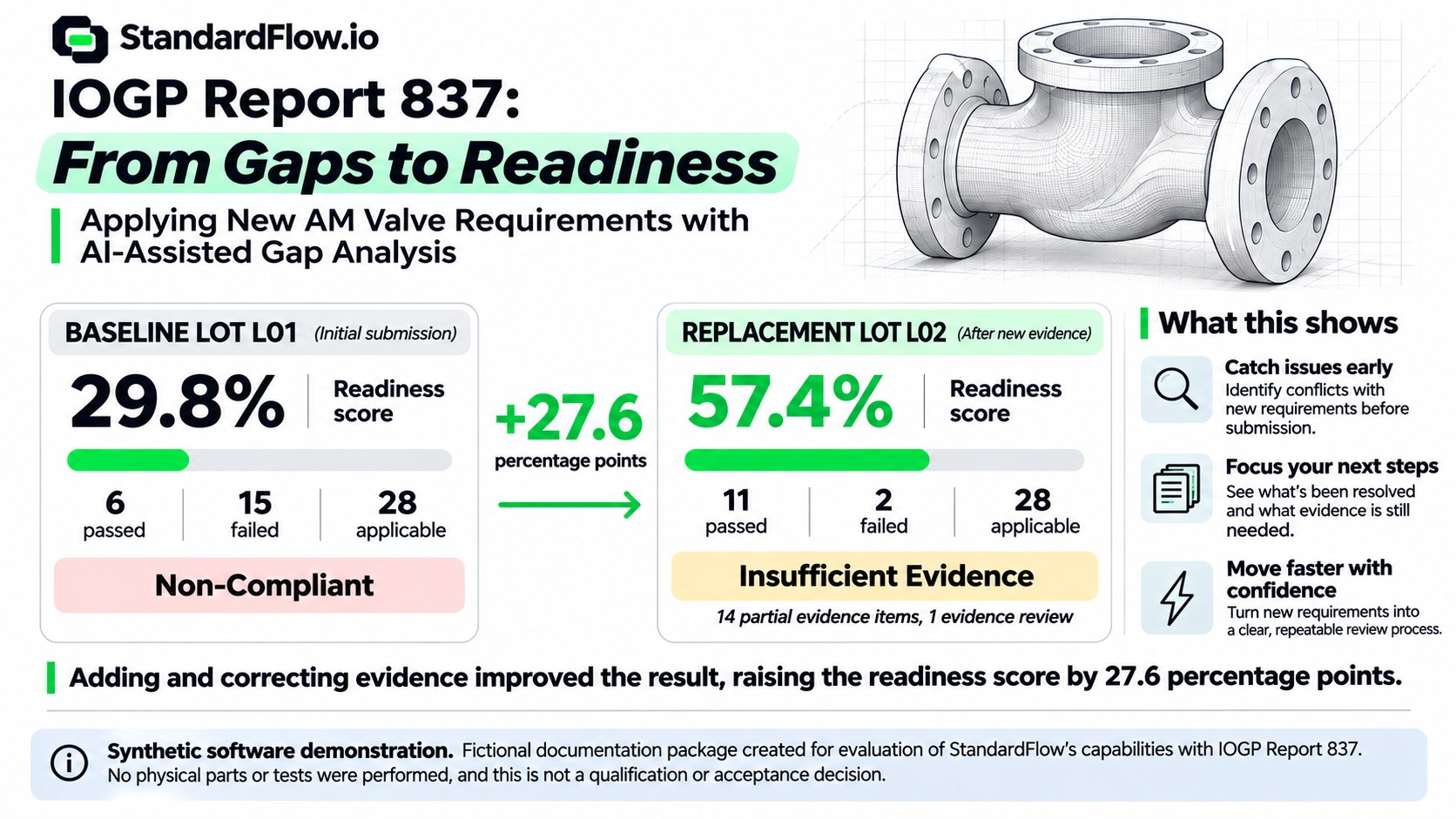
Within a day of Report 837’s publication, StandardFlow had conducted a controlled synthetic gap-analysis exercise using the new specification.

The exercise involved two fictional manufacturing lots. The initial package contained deliberately introduced problems, while a separate replacement lot included revised manufacturing records, additional testing information, and improved documentation.
Each package contained 16 documents covering purchaser requirements, manufacturing procedures, material records, laboratory results, inspection reports, and supplier documentation.
StandardFlow compared those records with requirements drawn from Report 837, examining what the evidence supported and what remained unresolved.
The exercise was entirely synthetic. No parts were manufactured, no physical tests were conducted, and the documentation was created specifically for software evaluation.
Several findings illustrate how this approach could support real qualification work.
Catching problems before they reach the customer
One important finding concerned a prohibited manufacturing repair.
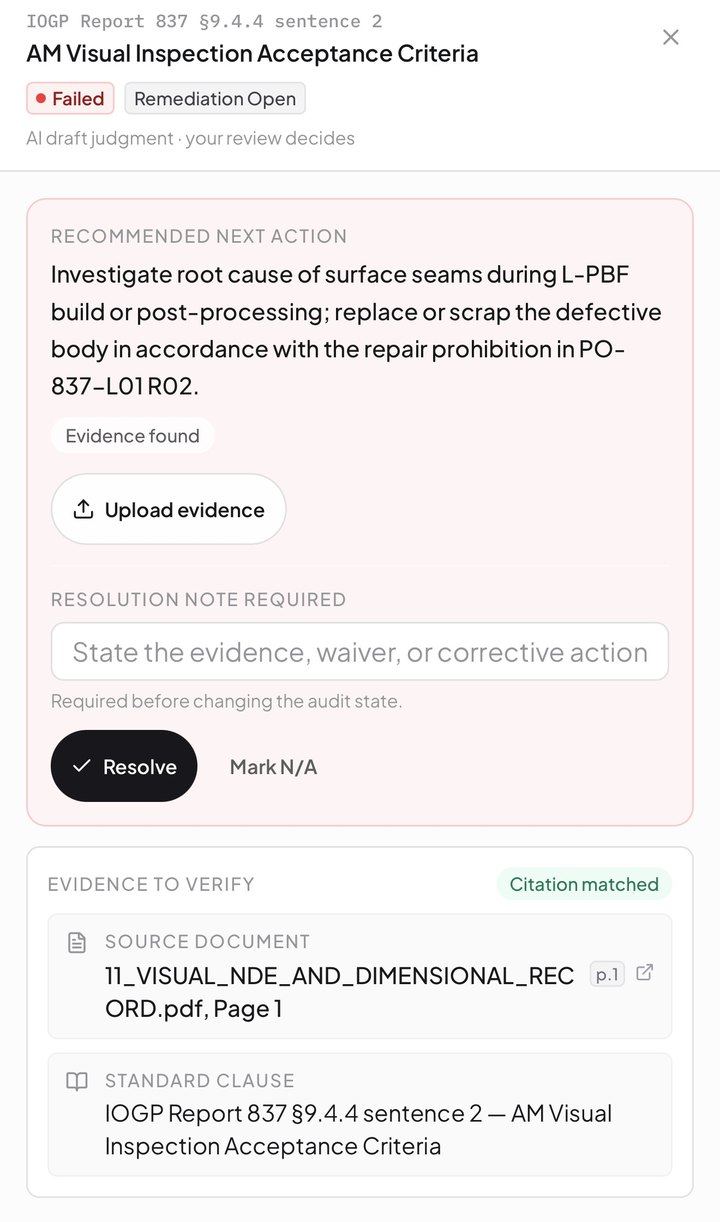
In the initial fictional package, the manufacturing records showed that a weld repair had been performed on the printed valve body. StandardFlow identified the operation as conflicting with Report 837’s prohibition on repairing additively manufactured valve components.
The replacement-lot documentation, by contrast, recorded that no such repair had occurred.
For a manufacturer, identifying this kind of issue during an internal review could help prevent an unsuitable component from advancing through the qualification process. For a purchaser, the finding provides a specific, traceable issue to investigate rather than a general concern about documentation quality.
A prohibited physical repair cannot be corrected merely by changing paperwork. The exercise therefore used a separate fictional replacement component, preserving the original manufacturing history.
Making sure manufacturing follows the right requirements
The analysis also examined whether the manufacturing records aligned with the qualification level selected for the component.
In the initial package, StandardFlow identified a mismatch between the level specified by the purchaser and the level recorded during manufacturing.
The replacement package contained consistent declarations, which the subsequent analysis recognized.
This matters because different applications and component types can require different levels of manufacturing control and supporting evidence.
For suppliers managing multiple customers and qualification routes, an early check could help identify inconsistencies before they become more costly problems.
For customers, it could make it easier to establish whether the supplier’s documented approach matches the agreed requirements.
Recognizing improvements while identifying remaining gaps
Additional documentation does not necessarily mean a component is ready for acceptance.
In the demonstration, the initial package lacked tensile testing across the component’s specified operating temperature range.
The replacement package included additional fictional test results at the relevant temperature endpoints. StandardFlow recognized that the evidence had improved, while retaining questions about whether the complete qualification requirements had been demonstrated.
The analysis also identified unresolved matters involving referenced manufacturing standards, material qualification, and supporting inspection documentation.
For a supplier, this could help direct the next round of documentation and testing toward specific outstanding questions.
For a purchaser, it could help distinguish between evidence that has been submitted, evidence that is still missing, and decisions requiring further engineering review.
What this could change for manufacturers and energy companies
The opportunity is to make qualification preparation more organized and repeatable.
A manufacturer preparing a new printed component could review its documentation against the relevant requirements before submitting it to a customer. Missing records, conflicting information, and unresolved requirements could become visible earlier in the process.
An energy company evaluating a supplier could use a structured review to identify which claims are supported and where further evidence is needed.
Engineering and quality teams could spend more time evaluating consequential technical questions, with findings linked to the underlying documentation.
As new AM specifications are published, this type of workflow could also help organizations begin assessing their existing processes and documentation against newly introduced requirements.
These are potential benefits, not measured outcomes from the StandardFlow demonstration. The synthetic exercise has not established time or cost savings, and further testing is needed to evaluate accuracy and reliability across representative projects.
The reports contain unreviewed AI-generated assessments, and our evaluation identified remaining software inconsistencies that are being addressed. No engineering qualification or acceptance decisions were made.
The objective is to give users a clearer understanding of where they stand, what their documentation supports, and what needs to happen next.
Helping AM become a practical option for energy
The publication of Reports 820 and 837 reflects growing industry attention to the qualification and procurement challenges that have limited broader adoption of additive manufacturing.
The potential advantages of producing parts on demand are compelling, particularly where supply chains are complex and equipment availability matters.
Turning those possibilities into routine practice requires manufacturers and customers to establish a repeatable path from production to documented acceptance.
Report 837 provides more specific requirements for certain 3D-printed valve components. Tools such as StandardFlow could help make those requirements easier to apply by connecting technical expectations with the manufacturing evidence intended to demonstrate them.
Engineers, purchasers, and the relevant acceptance authorities remain responsible for deciding whether a component is suitable for its intended service.
The broader opportunity is to make qualification work more transparent, consistent, and manageable as additive manufacturing expands within the energy industry.
Know where you stand. Know what comes next.